Baby the Rain Must Fall Steve Mcqueen Behind the Scenes
Flesh-and-blood characters, fine writing, and sensitive performances distinguish Baby the Rain Must Fall, a haunting character written report from author Horton Foote and director Robert Mulligan. Though its slow pace, lack of plot, and subtle shadings might examination your patience, this finely crafted, underrated film delivers on many levels.
Babe the Rain Must Fall
Theatrical Release Appointment: Jan 15, 1965
Blu-ray Release Date: May 21, 2019
Directed by: Robert Mulligan
Starring: Lee Remick, Steve McQueen, Don Murray
Blu-ray Special Features: Trailer
Writer Horton Foote specializes in slice-of-life stories chronicling the daily struggles of apparently Southern folk. Almost are straightforward, unproblematic tales that never possess a definite beginning or stop. They oftentimes showtime in the heart and stop there too, leaving enough of dangling threads for readers and viewers to contemplate. Plots don't seem to matter much to Foote; for him, it'southward the characters that count, and over the course of a half-century career he crafted a gallery of memorable figures. (Carrie Watts in The Trip to Bountiful and Mac Sledge in Tender Mercies are peradventure his ii most famous creations.) All speak a simple language, and watching them collaborate, evolve, and struggle with everyday bug is virtually always a rewarding feel.
In Babe the Pelting Must Fall, Foote employs his patented style over again, this time in an adaptation of his play, The Traveling Lady. Subtle, thin, and quietly moving, this low-key and often overlooked drama possesses a lovely menses and mood that go on us riveted throughout, despite its deliberate pacing and minimal plot. Director Robert Mulligan strikes just the correct tone, and never tries to over-tell the story. With lyricism and restraint, he brings Foote's drama to life, and, simply like he did a few years earlier with To Kill a Mockingbird (which Foote as well adjusted), masterfully blurs the lines between cinema and literature.
We starting time run into Georgette Thomas (Lee Remick) and her adorable little daughter Margaret Rose (Kimberly Block) as they travel on a motorcoach toward the sleepy town of Columbus, Texas. Notified that her husband, Henry (Steve McQueen), who was bedevilled of killing a human in a barroom brawl a few years earlier, has received parole, Georgette plans to rekindle their relationship and innovate him to the daughter he has never seen. The family reunion is understandably stilted and awkward, just Henry and Georgette try to forge a life together.
Georgette, however, must compete for her hubby'south affection. Music is Henry'due south first and strongest love. He finds himself torn between his aching want to pursue a career as a rockabilly singer/songwriter and his burgeoning domestic responsibilities. Georgette fully supports Henry's dream, but convincing the crotchety, domineering Miss Kate, Henry's abusive adoptive mother, is an impossible task. Miss Kate made Henry promise to enroll in nighttime school and learn a trade as a condition of his parole, just Henry only feels alive when he's performing and tin't resist the attraction of the stage.
The wounds Miss Kate inflicted on the immature Henry take never fully healed, and his hatred and fear of the bitter quondam adult female often clouds his judgment. A violent temper and penchant for liquor likewise conspire to demolition Henry's precious, only oh-so-tenuous new life. Georgette tries her best to be a steadying influence, and Henry'due south childhood pal Slim (Don Murray), now the boondocks'southward deputy sheriff, does what he can to keep his friend on the straight and narrow, only both accept problem stemming Henry's volatile tendencies and soothing his childhood scars.
Life in a sleepy, judgmental Southern town is well-worn territory for Mulligan and Foote, and their experience shows. Few details escape their gaze equally they meticulously depict the wind-swept temper and uptight attitudes of rural Texas. Mulligan weaves an intimate spell and rarely breaks it, allowing viewers to feel an affinity with Georgette and Henry that lasts throughout the film. Yet similar the characters information technology depicts, Babe the Rain Must Fall stumbles at times. Sketchy details and questionable motivations occasionally cloud the action, and McQueen – whose character performs three songs, including the infectious title melody – can't lip-sync to salve his soul. Luckily, the literate screenplay, sensitive direction, and impeccable performances make it easy to forgive any faults.
Remick and McQueen act with such natural and heartbreaking grace information technology's incommunicable not to identify on some level with their characters. Both contribute mesmerizing portrayals chock with realism and truth. Remick underplays to perfection and exhibits a serenity and purity of spirit that add together even more radiance to her archetype beauty. She fills her tender, marvelously shaded performance with deep emotion and deceptive strength, and her brilliant outlook in the confront of considerable turmoil and uncertainty is inspirational.
McQueen, still, is the real surprise. His eyes and posture brilliantly convey Henry'southward inner conflicts and neuroses, while his repose intensity adds wrenching layers to Henry'southward desperate ambition, unrealistic dreams, and divided loyalties. This is a different Steve McQueen – gentle, vulnerable, tortured, just still tough and manly – and his admirable work just makes one wish he pursued similar roles more oft. Here, he flexes some impressive dramatic musculus, and, together with Remick, molds Baby the Rain Must Autumn into a memorable and moving film.
The Blu-ray
Twilight Time presents Baby the Rain Must Fall in its original attribute ratio of 1.85:1. The 1080p/AVC MPEG-4 transfer, care of Sony, is a dainty upgrade from the 2004 DVD. Though a off-white amount of print damage afflicts the opening title sequence, once the narrative begins the source material is largely free of whatever nicks or marks. Grain is axiomatic merely well resolved, preserving the integrity of Ernest Laszlo's naturalistic cinematography that brings the arid, dusty, wind-swept setting to brilliant life. Blacks are lush, whites occasionally run hot, and the grays in between flaunt plenty variance to supply a palpable sense of depth. Transitions can exist a bit crude and a few scenes appear slightly soft or overly bright, but shut-ups crackle with clarity, emphasizing McQueen'south ruggedness and Remick's fresh-faced beauty.
The DTS-Hard disk Chief Audio mono rail supplies articulate, well-modulated sound. A wide dynamic range keeps distortion at bay and embraces Elmer Bernstein'southward dramatic score. Dialogue is like shooting fish in a barrel to sympathize throughout. Effects like wind and footsteps are crisply rendered. No age-related hiss, pops, or crepitation intrude.
In addition to an eight-page booklet that includes an essay by pic historian Julie Kirgo, a few scene stills, and a color reproduction of the motion-picture show's poster art, the just supplement is the original theatrical trailer. Like all Twilight Time releases, this is a limited edition disc of 3,000 copies.
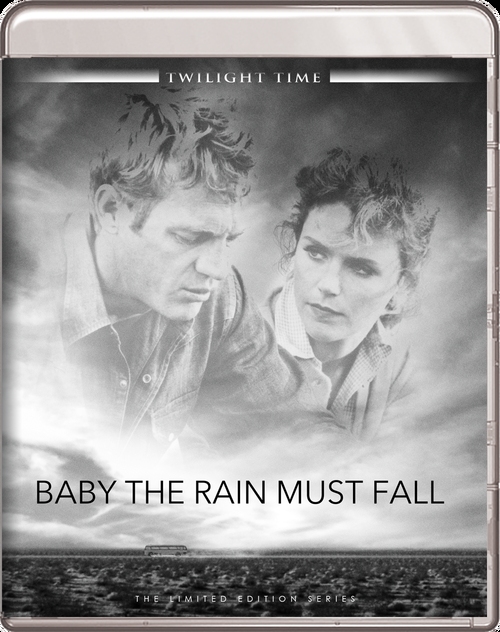
Babe the Rain Must Fall Blu-ray – Buy at Twilight Time Movies

Source: https://www.highdefdigest.com/blog/silents-to-seventies-baby-the-rain-must-fall/
0 Response to "Baby the Rain Must Fall Steve Mcqueen Behind the Scenes"
Post a Comment