what were the last two cities in the south to be captured
Filled with new opportunities, electric lights, and a diverseness of entertainments, cities were more than bonny than they had ever been in the 1920s and 1930s. The scene of an New York subway by artist Lily Furedi serves to help illustrates how new technologies of this era, similar mass transit, contributed to the exponential growth of urban areas. The painting also exemplifies the diverse interactions of an urban environment; blackness and white, rich and poor, men and women all sit together, mixed in the same infinite with no evidence of societal discomfort. In other areas of the country, however, things were not every bit agreeable for African Americans. Rise racial tensions in the South are brought to light in Bar and Grill, depicting a segregated bar in 1940s New Orleans; blacks and whites separated past a floor to ceiling partition. The scene came as a shock to the artist, Jacob Lawrence, who hailed from the non-segregated Northward. This time menstruation was a pivotal time for African Americans. Known equally the Smashing Migration , blacks traveled northward to urbanized areas looking for jobs, economic prosperity, and opportunity. Between 1900 and 1940, the black population of the five boroughs of Manhattan rose from 60,000 to more than than 400,000. The excitement of this new life was unimaginable in the small-scale towns of the Southward, so many remained in New York. This largely transplanted community faced two enormous tasks: to explore the cultures and civilizations of Africa, and to redefine the black experience in the United States. They did this in the form of a move called the Harlem Renaissance , which began after World State of war I in the New York City neighborhood of Harlem. African American poets, musicians, writers, and painters gathered in this predominantly black expanse to create works of fine art that celebrated the uniqueness of African American culture and what blacks had achieved, despite great odds, in the United States.
Download a Pedagogy Poster PDF of Bar and Grill
Activity: Discover and Interpret
Born in New York, Jacob Lawrence had only second-hand knowledge of the South, passed down from his Virginia-built-in female parent and Due south Carolinian begetter. He remarked in 1961: "[In 1941] if you weren't born in the Due south, your parents were. Your life had a whole Southern flavor; it wasn't an alien experience to y'all even if you had never been at that place."
In 1941, he and his wife, artist Gwendolyn Knight, traveled to New Orleans and were struck by the harsh segregation and bigotry they experienced. Lawrence began making paintings that documented the life of African Americans in New Orleans, includingBar and Grill. What information can we learn about segregation and life in the South in the early 1940s from this painting? What clues does Jacob Lawrence give u.s.?
Observation: What do you meet?
Describe the physical layout of the bar.
A wooden wall bisects the room, running flooring to ceiling, from the entrance doors to the bar. The wall is not solid, and some light shines between the wooden slats. The wall does not bisect the room every bit. The space on the left, where nosotros see only White patrons, is larger than the room on the right side of the wall, reserved for Black customers. A long solid bar in the foreground of the painting links the 2 sides of the room. The bar appears to tilt up slightly at the right stop of the composition, and coupled with the diagonal line of the ceiling sloping slightly downward, makes the room on the right appear smaller and more than crowded.
What amenities are available to the customers on either side?
 Notice the ceiling fan on the left side, bachelor to cool the air for White customers but. Drinking spectacles line a shelf backside the bar, nonetheless are kept separate for Black and White customers. On the left, spectacles are arranged in a pyramid; on the right, they are lined up. Paralleling the divide glassware are separate faucets or spigots, two on the right side of the wall and 2 on the left. Each set up has a spout with black tubing running down, outside of the frame.
How are the patrons depicted on either side of the dividing wall? Does their feel differ?
 Behind the bar, a white barkeeper reads a newspaper on the left side of the painting, on the side of the business firm reserved for White patrons. 3 men drink at the bar, the lines of their lapels, shirts and neckties contrasting with their black and white suits. Their faces seem serious and the angles of their bodies cause the eye to travel one to the next, then dorsum to a figure in scarlet and a scowling figure behind them.
Equally nosotros turn our attention to the right side of the bar, we brainstorm to annotation differences. The night-skinned figures here are smaller in scale, which makes them seem both far away and kid-similar. The adult female in cerise whose v-shaped neckline rhymes with the drinking glass in forepart of her sits with eyes downcast. A man to her right smokes, but has no ashtray. Two figures virtually the door overlap with arms outstretched and interlocked fingers, perhaps dancing.
Estimation: What does it mean?
Traveling to the South for the starting time time, Jacob Lawrence makes the deeply-entrenched segregation that he and his married woman experienced abundantly clear. Black and White patrons in the bar are separated by a wall and made to employ carve up entrances, and the services (as symbolized by the barkeeper) appear to be more readily provided to White customers. Amenities, in the form of the ceiling fan and ashtray, are not bachelor to Black patrons. Water faucets and glassware are kept separate. White customers are depicted equally equal to i some other in size and unified in the artist's use of color, and their facial expressions appear unwelcoming.
Download (PDF)
Historical Groundwork
The Jim Crow South
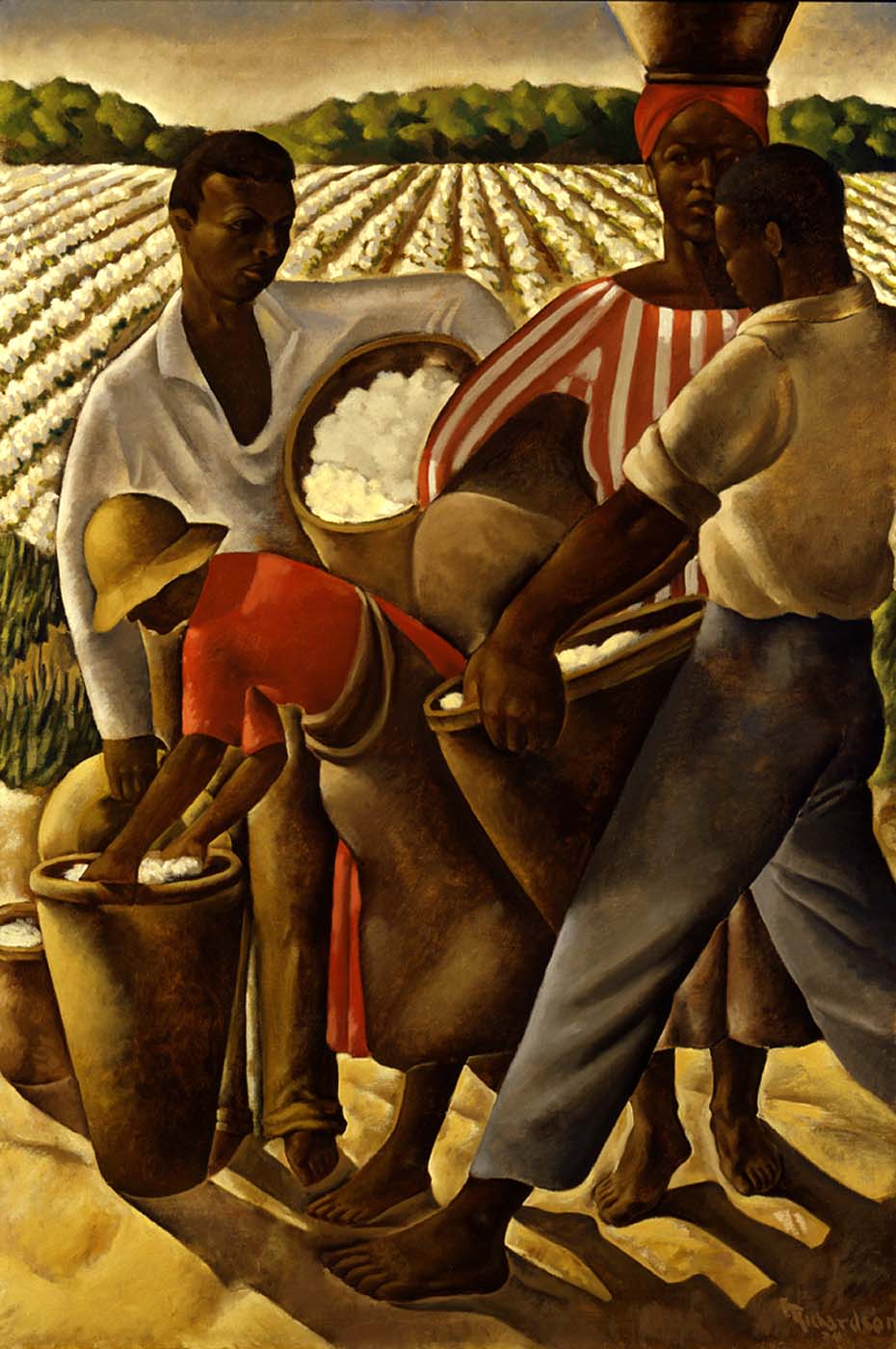
Employment of Negroes in Agriculture 1934, Earle Richardson, Smithsonian American Art Museum
Though the Reconstruction era (1865-1877) had sought to right the wrongs washed to African Americans during slavery, not much had changed in the mode of their civil rights afterward Reconstruction ended. In fact, the civil rights of blacks began to be further impinged upon past a series of laws, collectively called Jim Crow laws, designed to segregate, discriminate, and intimidate.
The tightening of segregation began with sharecropping . The Southern economy was dominated by agriculture. The few factories and mills that did exist preferred to employ white labor over black labor due to the prevailing racist stereotype that blacks were lazy and shiftless. Consequently the majority of freed African Americans were forced into sharecropping – a system of agriculture in which a landowner allows a tenant to use his land in render for a share of the crop produced on that land.
Former slaves had expected that the federal government would provide them with land as a compensation for the work they had done before emancipation. A plan known colloquially every bit " forty acres and a mule ," whereby each formerly enslaved family would receive "not more than xl acres of tillable ground." However, President Andrew Johnson enacted a Reconstruction law which ordered that all land under federal control be returned to its previous owners – the white landowners. Freed slaves were informed that they either had to sign labor contracts with the landowners or be evicted from the land.
The Civil Rights Act of 1875 was meant to guarantee freed blacks equal treatment in public accommodations such as hotels, public transportation, and theaters. Just in 1883, several provisions of the Human activity were ruled unconstitutional by the Supreme Court in a group of five cases collectively called the Civil Rights Cases. The majority dominion held that the provisions were unconstitutional because Congress did non have the authorization to regulate individual diplomacy nether the Fourteenth Amendment , which protected a person's civil rights from being violated by the state, not by individuals – such equally when a hotel refused to rent a room to an African American. The Supreme Court held that the Human action addressed social rather than civil rights, and was consequently invalid.
The Supreme Court'due south decision created a ripple upshot across the South. State legislatures began enacting laws legalizing segregation in public places. These Jim Crow laws imposed segregation and denied African Americans equality and political rights. The Supreme Courtroom upheld these Jim Crow laws in the 1896 landmark example Plessy five. Ferguson , which maintained the constitutionality of the "carve up but equal" doctrine.
New Orleans: Segregation in the Deep South
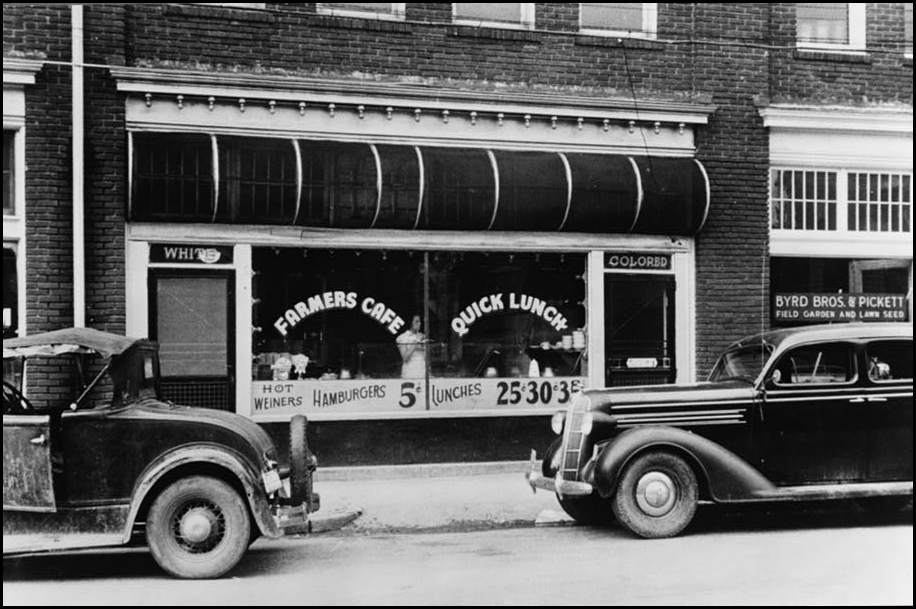
A café near the tobacco market, Durham, North Carolina, depicting separate "white" and "colored" entrances, 1940, Jack Delano, Courtesy of the Library of Congress
Following the end of Reconstruction, New Orleans became increasingly segregated as Jim Crow laws were introduced by law makers who wanted to come across the Southward returned to the days of white privilege that existed earlier the Ceremonious State of war. Between 1900 and 1950 New Orleans' population grew slowly, yet shifted dramatically. A city with once heterogeneous communities became increasingly segregated nether Jim Crow. Ironically, New Orleans did non start out as such a segregated city. In the early nineteenth century New Orleans' population was increasingly various, divided evenly into thirds: white, free people of color, and slaves. This can be attributed to New Orleans' unique geographical location. A port city, information technology received slaves equally office of the Triangular Trade routes. It remained a transportation hub throughout the starting time half of nineteenth century with New Orleans' booming cotton economy.
Yet segregation was fully entrenched in New Orleans when artist Jacob Lawrence arrived there in 1941. Segregation in public housing created by the New Deal and on a new street car system kept whites and blacks further apart. Legislation required that Lawrence ride in the dorsum of urban center buses and live in a racially segregated neighborhood. The creative person experienced firsthand the daily reality of Jim Crow segregation, which he captured in Bar and Grill and other paintings that dealt with what he called the "life of Negroes hither in New Orleans." Equally an African American who grew up in the Northward, Lawrence merely had secondhand knowledge of the South, yet he felt connected with the region'due south culture through association. He after remarked, "Any Negro person has a stiff human relationship to the South. . . . Your life had a whole Southern flavour; it wasn't an alien experience to yous fifty-fifty if you had never been there."
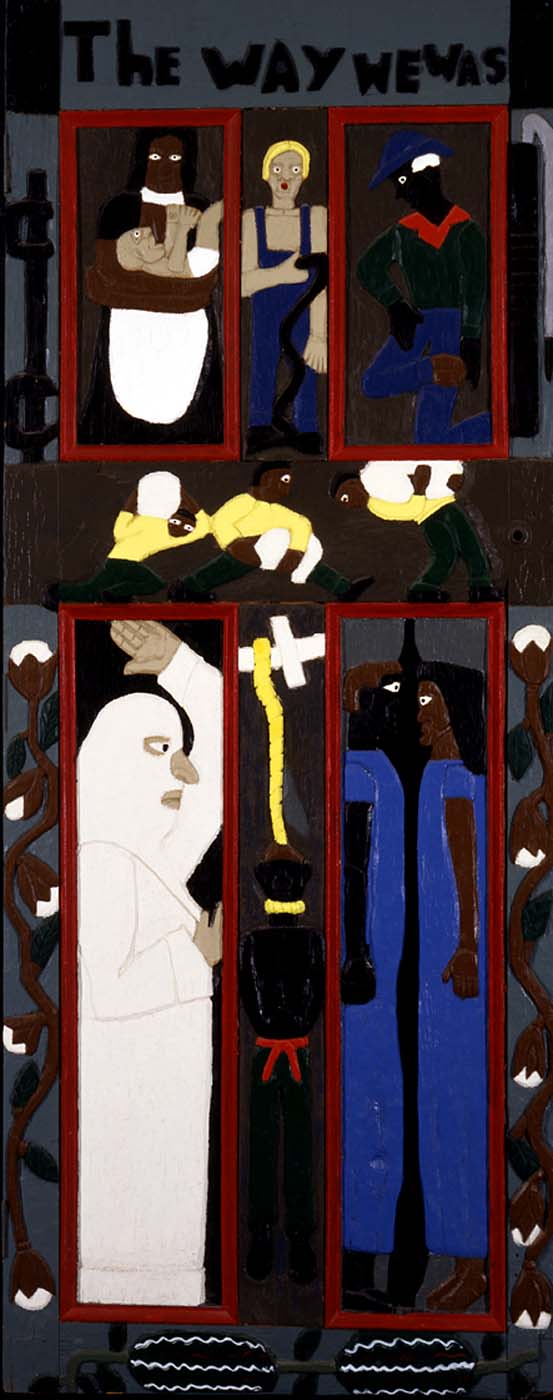
The Way We Was, 1990, Herbert Singleton, Smithsonian American Art Museum
Most confined in 1940s New Orleans were entirely segregated – each whole establishment beingness reserved exclusively for white patrons, or for black patrons. Jim Crow laws had re-established the literal and figurative wall between blacks and whites. It is in this climate that Jacob Lawrence painted Bar and Grill, conjoining separate, segregated businesses into one bar divided down the centre, between blackness and white patrons. The message that blatant segregation and systematic racism was a reality in the American South seems clear.
Leaving the Southward
Many African Americans were eager to escape the legal arrangement in the Due south and the miseries information technology acquired for black citizens. Past law, African Americans were denied admission to the same institutions that were used by whites, similar hospitals and schools. They likewise had few legal rights. Whites could assault or even kill blacks with little fear of being tried in a courtroom of law or imprisoned. The discriminatory Jim Crow laws helped to perpetuate a social and economical system that kept Southern blacks subjugated . The majority of Southern African Americans lived in poverty. Those who did manage to obtain an education or excel at a profession risked becoming victims of violence by whites who did non want to see them rise higher up their supposed position.
Many young African Americans who made the conclusion to journeying due north had experienced the hardships of life on sharecropper farms, subjected to Jim Crow laws, and abuse and intimidation from the Ku Klux Klan . They saw how their parents' generation were subjected to the injustices of Southern society. Their reasons for migration were numerous, but overall, the want to better their status prevailed above all else – they wanted to experience the freedom and opportunities that the North offered. At this time in the state's history, industrial expansion created economical opportunities for these rural migrants. And opportunities were only growing for blacks in the Due north with the onset of World War I expanding the booming industrial economy. The stage was now set for the Not bad Migration .
Download (PDF)
The Slap-up Migration

Source: Rutgers Cartography and Schomburg Heart for Inquiry in Black Culture
In the years preceding World War I , a slow merely steady migration of African Americans from the rural Due south to the urban North began. This was the beginning of a phenomenon called the Great Migration . The rationale for leaving the South was different for every migrant, but largely, the promise for a better life was paramount. The booming industrial economy in World War I-era America contributed to a wealth of job opportunities and better pay for African Americans. In the n, their children would have the opportunity to seek an education. Migration likewise offered African Americans the chance to escape discrimination, segregation, and the Jim Crow laws that violated their civil rights.
Prior to World State of war I, the chances for African Americans to country a lucrative job in the manufacturing industry were slim. They were blocked from these types of positions past unions who wanted to preserve the higher paying jobs for white workers.Simply that all began to change with the advent of the war in 1914 when immigration to the United States from Europe came to a virtual standstill. Although the The states was not straight involved with the war, American industry produced weapons and other state of war supplies. The need for more than workers was urgent – without a steady menstruum of white immigrant employees, booming state of war-time industries were desperate for workers. Racial prejudice had kept companies from hiring African Americans, but the profit they stood to make during the state of war-time economic system overrode any hiring prejudice.
Desperate for workers, many industries key to the burgeoning state of war economy like steel mills and railroads actively recruited African Americans. Some went as far as to transport recruiting agents downward to largely black-populated areas of the Southward to search for workers. Railroad companies were the kickoff to recruit. The Pennsylvania Railroad recruited 16,000 African Americans in 1916 as unskilled laborers. Many impoverished blacks seized this new economic opportunity and migrated north where the work was plentiful. According to a 1917 survey in The Crisis magazine, the number i reason to get out the Southward was poor pay, followed past lack of good schools, discrimination, and oppression. Farm workers in the South fabricated on average $0.75 per day, whereas in cities, factory work brought wages as high equally $iv.00 a day. Those early migrants wrote back dwelling house to their friends and family expressing just how abundant employment and loftier wages were: "Nix here but money, and it is not difficult to get," wrote ane worker.
Past 1920 more than 1.v meg blacks were working in northern factories and other urban jobs. Blackness newspapers aided the migration fever by ad the advantages of living and working in northern cities, and publishing stories of recent migrants who had found success. The messages these migrants sent dorsum home confirmed stories of higher wages and less discrimination. The letters were read aloud in barbershops, churches, and meeting halls. One migrant, living in Chicago, wrote home about the abundance of work:
I am quite decorated. I work in Swifts packing Co. in the sausage section. My daughter and I work for the aforementioned company – We get $1.50 a day and we pack and then many sausages we dont have much time to play just information technology is a matter of a dollar with me and I feel that God made the path and I am walking therein. Tell your hubby work is plentiful hither and he wont accept to loaf is he want to piece of work.*
Some other migrant wrote of the freeing experience of not having to kowtow to whites as he would have in the South:
With the aid of God I am making very good I make $75 per calendar month. . . . I don't have to work hard. dont accept to mister every niggling white boy comes along . . . I can ride in the electric street and steam cars any where I get a seat. I dont care to mix with white folk what I mean I am not crazy about being with white folks, only if I take to pay the same fare I have learn to want to the same acomidation.*
[*The spelling and grammer mistakes in the quotes above have not been corrected and appear verbatim as on the primary source document.]
With more and more than African Americans leaving the South, a backlash soon occurred against the labor agents who were facilitating the migration. Southern states were angered, having found their economies struggling and their cheap source of labor diminishing. But past this fourth dimension every bit word spread nearly the opportunities the North held, the role of labor agents became unnecessary and more and more migrants fled the South.
It is a misconception to think that the average migrant was a poor sharecropper. In fact, the bulk of black migrants came from southern towns and were accustomed to a more than urban environment. They were moderately well-off and were generally more educated than the average African American in the South. Many came from a skilled professional class, having worked as teachers, lawyers, social workers, and writers.
In one case migrants had fabricated the difficult determination to leave their families behind to drift, the question became how to make the journey. Migrating was expensive, which was why families rarely migrated together. It was the immature men who found jobs as unskilled industrial laborers who were the first to migrate. Equally the role of labor agents diminished, African American could no longer count on northern businesses to pay their way. Many had to sell all of their possessions. Some borrowed money from friends and family. Often, families pooled their money together to send a younger homo in the family unit n, with the expectation he would postal service money back dwelling house to assistance the remainder of the family follow him.
The trip north could be made by train, bus, equus caballus-drawn cart, or fifty-fifty by human foot. The journey was a long, grueling feel. Travelers were confronted with segregated waiting rooms at omnibus stops, and overcrowded, segregated railroad train cars. The destination of the migrants were the large industrial centers of the northward – Chicago, Detroit, Pittsburgh, and New York Metropolis, but many stops were oftentimes made along the way. Painter Jacob Lawrence recalled that his family was "moving upwardly the declension, as many families were doing during that migration. . . . We moved up to various cities until we arrived – the concluding two cities I tin retrieve before moving to New York were Easton, Pennsylvania, and Philadelphia." In one case in their destination city, migrants often relied on the help of African American service organizations, like the National Urban League in New York Metropolis and the National Clan for the Advocacy of Colored People (NAACP), to help them find jobs and living arrangements. The league besides assisted migrants in their move from the South, helped blackness workers prepare for jobs in manufacturing industries, and lobbied white employers to provide employment opportunities to blacks.
The Backwash of Migration
From 1870 to 1910 approximately 470,000 African Americans left the South. In the adjacent ten years, from 1910 to 1920, some other 450,000 migrated. The migration only came to a halt with the beginning of the Great Low. The severe economical downturn dried upwardly virtually all employment opportunities in the North. Conditions for all Americans would not ameliorate until the start of President Franklin D. Roosevelt 's New Deal . This series of domestic programs improved economical conditions and spurred a 2d wave of migration from the South, known as the Second Great Migration , a wave that would last throughout the 1960s.
But it was the first wave, the Great Migration, that arguably had the greatest touch on on northern cities, non just in terms of population growth, but with regards to the cultural motility that growth spurred. Would-be migrants in the S had heard tales of theaters with musicals and films featuring black performers, nightclubs featuring the all-time African American musicians, and baseball games played by all-black teams. The Northern cities to which the Southern migrants journeyed emerged as hubs of cultural, social, and artistic creativity and interaction. Information technology wasn't a dream. This cultural movement which took place across a multitude of northern cities – the Harlem Renaissance – became reality for hundreds of thousands of African Americans.
Download (PDF)
New York Metropolis: The Harlem Renaissance and Across
When the Great Migration began, rural African Americans came to Northern cities to meliorate their circumstances. The hardships and abuses they had endured in the South propelled them to seek a meliorate futurity in the North, i of economic prosperity and freedom from persecution and Jim Crow laws. These Southern migrants joined established African American communities, strengthening church building groups and fraternal societies. By 1920, the majority of the African American population in northern states was full-bodied in the cities of Cincinnati, Chicago, Columbus, Detroit, Pittsburgh, Philadelphia, and New York; all industrial centers of production. In New York City, African Americans flocked to the urban center'southward Harlem neighborhood – sowing the seeds for what would come to be known equally the Harlem Renaissance , a cultural, social, and artistic revolution that flourished in the 1920s.
During the 1920s and 1930s, Harlem was a haven, a place of cocky-discovery, cultural sensation, and political activism for African Americans. Information technology nourished an artistic flowering of unprecedented richness. It was literature, painting, and music; information technology was movies, poetry, and jazz. This concentration of talented and socially-conscious African Americans produced immense talent – writers Langston Hughes and Zora Neale Hurston , artists Jacob Lawrence and Romare Bearden , musicians Bessie Smith and Duke Ellington , and activists like Marcus Garvey and A. Philip Randolph .
The apartment blocks and brownstones of Harlem were opened to black residents in 1905. Between 1900 and 1940, the black population of the v boroughs of Manhattan rose from threescore,000 to more than than 400,000. Black soldiers returning from World War I flocked to Harlem – perchance initially as a midway signal on their mode back dwelling. In their travels abroad they had experienced the freedom offered in European cities and had seen the popularity of American jazz in Paris and London. The excitement of this new life was unimaginable in the small towns of the Southward, then many remained in New York. This largely transplanted customs redefined the blackness experience in the United states.

The Library, 1960, Jacob Lawrence, Smithsonian American Fine art Museum
By the 1920s Harlem had become the most famous African American community in the world. The concentration of black men and women in Harlem produced a lively scene. The accumulation of books, journals, and ideas sparked interest in African music, images, and history. The 135thursday Street Library , depicted in Lawrence'due south The Library, became the cultural linchpin of Harlem. It was a resource for artists and thinkers, a coming together place, the site of violent intellectual debates, and a venue for plays and musical performances. In a cosmopolitan customs people expressed their enthusiasm for this new life through jazz, trip the light fantastic, theater, art, and writing. The Harlem Renaissance coincided with the Roaring Twenties and the Jazz Historic period . The impact of these movements had a drastic bear on on an private and collective level in both the African American community, equally well equally America's cultural industries. The contributions of African Americans profoundly benefited the moving-picture show, music, and theater industries.
Some, like the poet Countee Cullen , were Harlem-born; others like Langston Hughes migrated. A nineteen year old Hughes, born in Joplin, Missouri, arrived in Harlem in 1921 and vividly recalled his excitement of seeing Harlem for the outset time:
I can never put on newspaper the thrill of that clandestine ride to Harlem. I had never been in a subway before and it fascinated me – the racket, the speed, the green lights ahead. At every station I kept watching for the sign: 135TH STREET. When I saw it, I held my jiff. I came out onto the platform with 2 heavy numberless and looked effectually. It was still early morning and people were going to work. Hundreds of colored people! I wanted to shake easily with them, speak to them.
Hughes would become one of Harlem's most famous residents, a literary behemothic whose poems chronicled the struggles and joys of early twentieth century African Americans. He and other young writers and artists would take ownership of the Harlem Renaissance motility, giving a vocalization to the African American feel.
When Alain Locke published The New Negro in 1925, Harlem'south political and cultural facets gained a sharper focus. Literary contributions by Countee Cullen and Zora Neale Hurston spoke of the black feel, just Locke'southward volume offered far more than than a record of daily life with its joys and sorrows. Locke sought to reestablish art equally the cadre of black life. He argued that African Americans should limited an African art uncontaminated by the industrial age, rooted in pure ethnic craft and tradition. Through The New Negro, he called on African Americans to attain this chore.

Evening Attire, 1922, James VanDerZee, Smithsonian American Fine art Museum
Photographer James VanDerZee was the semiofficial photographer of Harlem's life and people. His images traveled throughout the state in magazines and volume illustrations. VanDerZee had a portrait studio, merely he as well worked on the street, recording the details of everyday life, both political and personal. His images helped disseminate sociological concepts on race articulated past African American leaders Due west.E.B. Du Bois , Alain Locke, and Marcus Garvey. Sculptor Augusta Brutal produced images that ranged from street urchins to idealizations of the African muse, and ran a series of schools for budding artists.
The artists of the Harlem Renaissance sought to explore and represent the African American experience in their work. They fostered a new sense of pride in the black community and provided a voice to the want of African Americans to at long terminal achieve a measure of equality in American lodge. The influence of these artists resonates far beyond the place and time in which they worked; it has been felt throughout the century and the whole of American culture.
A Changing City
In the nineteenth century, the city of New York had been characterized by a variety of country uses which separated people of different ethnic groups and economic classes. Merely every bit more and more than people poured into urban centers in the early on twentieth century, the spatial arrangement of people and economic activities became altered past innovations in mass transit and building construction. In New York Metropolis, the get-go subway opened in 1904, its tunnels excavated out of clay and rock past the vast numbers of largely Irish, Italian, and High german immigrants. Between 1900 and 1920, New York built 100 miles of subway tunnels. Thanks to the subway, people were no longer segregated to one function of the city. Those who had migrated to this evolving urban environment from the Due south experienced a vastly different world than the one to which they had been accustomed. Hungarian-American artist Lily Furedi'southward paintingSubway typifies this lack of segregation on the New York subway. Passengers of different races, classes, genders, and national backgrounds ride together with no sign of friction – a marked dissimilarity to the institutionalized racial segregation which was the case at this fourth dimension in the southern United States.
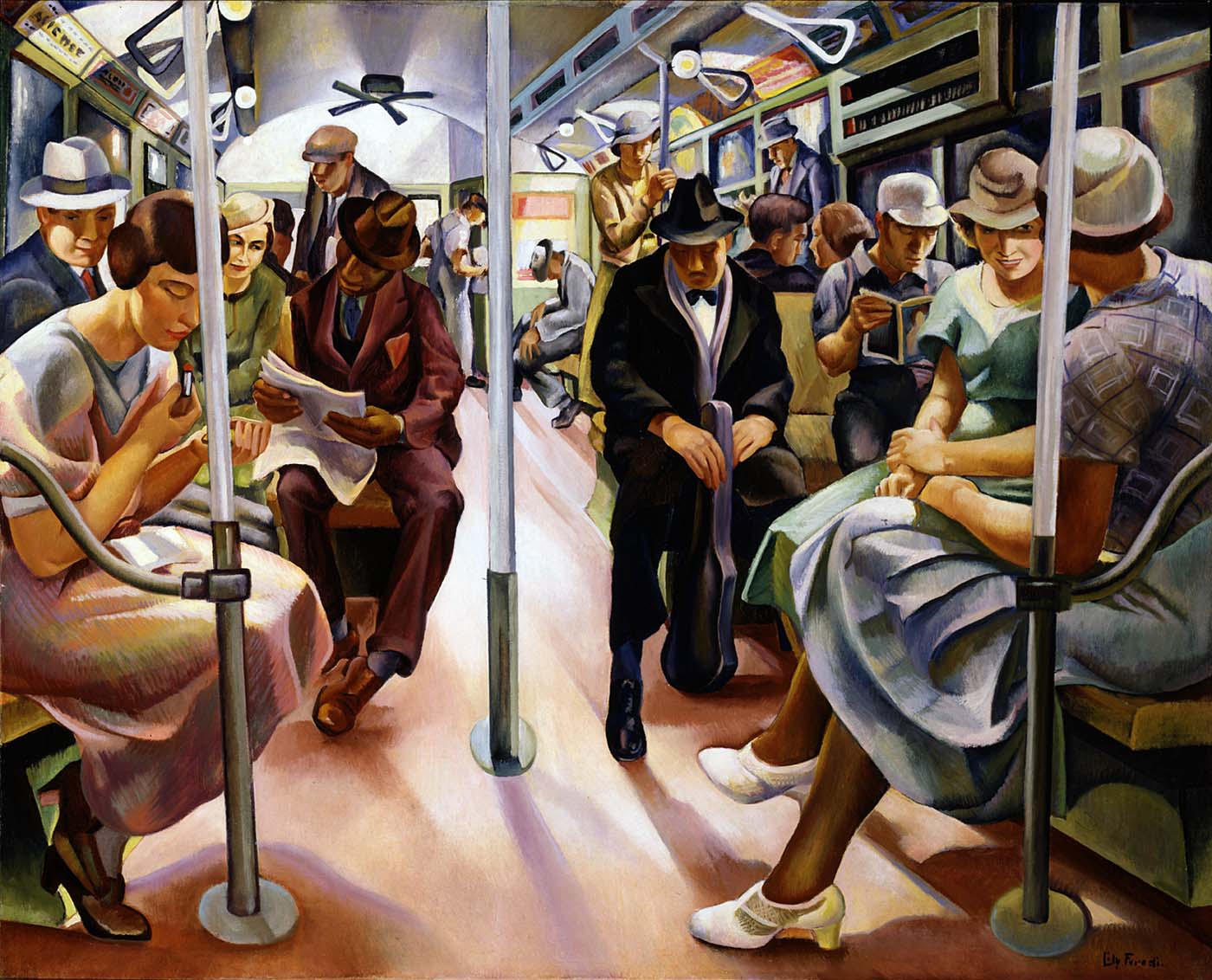
Furedi's clean, pleasant delineation of the interior of a subway auto is a especially optimistic view of a new train motorcar running on the new Eighth Avenue Line, built in 1932. She paintedSubway in 1934 for the Public Works of Art Projection (PWAP), the first of the New Bargain national art programs of the Great Depression. The PWAP suggested that artists depict aspects of "the American scene." Furedi, like many New York City artists, chose to testify a familiar attribute of urban daily life that would accept been familiar to millions of New Yorkers. People from all economic backgrounds could beget to ride the subway because of the traditional 5 cent fare. Newspaper articles from the 1920s note that people of all different national backgrounds rode together on the New York subway, frequently reading newspapers in wide range of languages, and casually reading over one some other'southward shoulders as nosotros run across happening at the left in Furedi's painting. Though the New York City subway organisation was non segregated, in that location had been some give-and-take of setting aside special cars for women – mostly to avoid problems of harassment. At this time, women had begun inbound the piece of work strength in big numbers. The women nosotros see in Furedi's painting may be commuting to work.
In the kickoff quarter of the twentieth century, women occupied jobs equally domestic servants or in factory work – peculiarly during the World War I years. When the war ended, many of these enterprising women moved on to sales jobs in department stores, or clerical and secretarial work. In 1920, the New York Times ran a headline that read, "the American Woman . . . has lifted her skirts far across any modest limitation." This commentary went beyond fashion – it was a an observation of the profusion of liberated women in the workforce. The Manhattan borough of New York Metropolis employed ten,000 part workers in the 1930s, nigh of whom were women. Part work was seen as a place where a woman could improve both her employment and her personal status. The modify in women's roles, as well as the massive African American migration to the Northward, identified a shift that was taking place in America from a rural, production-oriented economy to an urban, consumption-oriented economic system. Much of the work previously carried out within the home – nutrient grooming, care of the sick, product of habiliment – was now beingness performed by workers in restaurants, hospitals, and factories. In artworks similar to Furedi'south Subway, depictions of independent working women were closely aligned with the evolution of cities and the spaces of modernity. Black women especially took advantage of this irresolute environs and the wartime need for workers. In 1910, xxx per centum of black women in New York worked exterior the home in occupations that ranged from seamstress and dressmaker, to factory worker and secretary. Before the state of war, the only jobs open up to blackness women would have been those in the domestic and personal-service categories.
Download (PDF)
Primary Source Connections
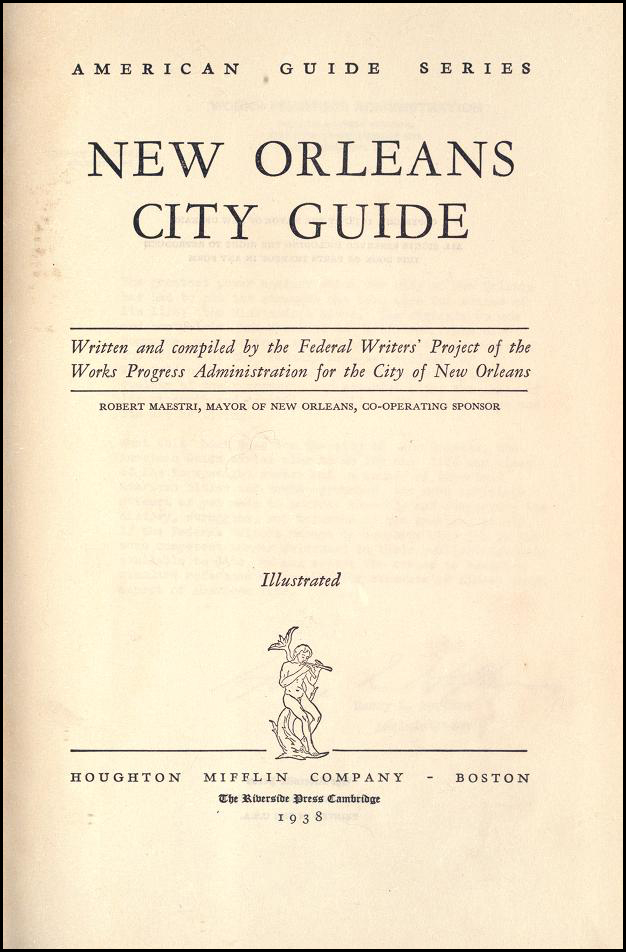 New Orleans City Guide, 1938, Federal Writers' Project of the WPA
Read it at Archive.org (folio forty)
The stark divisions between the aplenty facilities listed for white customers and the meager and cavalier listings of "negro" facilities gives ample evidence of the segregation that was in full force in New Orleans in the 1930s, not long before Jacob and his wife, artist Gwendolyn Knight Lawrence, arrived there. The post-obit is an extract:
The Negro night clubs of New Orleans are patterned afterwards those of Harlem. The proprietors visit Harlem to study the colour schemes and acquire the atmosphere of night clubs there, because 'it serves well along publicity lines.' Fifty-fifty the music and floor shows are handled in the Harlem manner – nothing less than 'crimson hot.' The tunes are loud but have the 'swing' that causes Negroes to move their bodies and tap their feet.
 "South Unable to Finish Negro Exodus," October 23, 1916,The Washington Times
View the commodity at the Library of Congress
This front folio headline of theWashington Timeshighlights the function of labor agents in bringing African Americans to the North, too equally the some of the difficulties blacks encountered during their migration.
Literary Connections
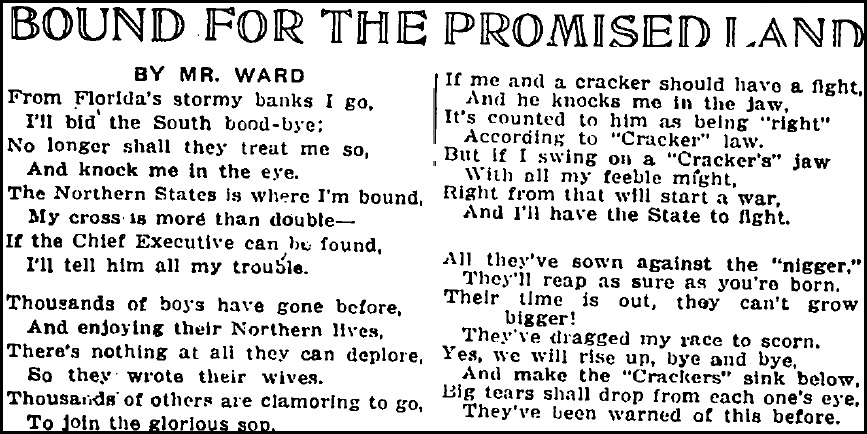 "Bound for the Promised Land" by Mr. Ward, inThe Chicago Defender, November 11, 1916
Download a transcript of the poem (PDF)
TheChicago Defenderwas arguably one of the most influential black-endemic publications to assistance spur the Cracking Migration past touting the advantages of living in the North. In this poem published in 1916, the narrator celebrates his decision to go out Florida and journeying north. He is equally excited to escape the restrictive laws of Jim Crow as he is to feel freedom in the Northward. His pro-migration opinion encourages the reader to "hold up your head with courage brave" and follow him on the journey north.
 "The Metropolis of Refuge" by Rudolph Fisher, in theAtlantic Monthly, February 1925
Read it at the National Humanities Center.org
This short story, originally published in the literary and cultural commentary mag the Atlantic Monthly, tells the story of King Solomon Gillis, a young black man from North Carolina who has recently arrived in Harlem as a fugitive on the run. Back abode, he accidentally killed a white human being – a crime which would likely be punished with a grisly death. In the South of the 1920s, whatsoever African American who killed a white person could be expected to be publicly lynched without the do good of a trial. The following is an excerpt that describes Gillis' inflow in Harlem.
Then slowly, spreadingly, he grinned at what he saw: Negroes at every plow; up and downward Lenox Avenue, upward and down 135th Street; big, lanky Negroes, short, squat Negroes; blackness ones, brown ones, yellow ones; men continuing idle on the curb, women, bundle-laden, trudging reluctantly homeward, children rattle-trapping about the sidewalks; here and there a white confront drifting along, but Negroes predominantly, overwhelmingly everywhere. In that location was assuredly no dubiety of his whereabouts. This was Negro Harlem.
"One Style Ticket," Langston Hughes, 1948
Read information technology at the National Humanities Middle.org
Langston Hughes (1907-1967) was an African-American poet, novelist, and playwright who is one of the bang-up icons of the Harlem Renaissance. In 1948, he asked artist Jacob Lawrence to illustrate his new poesy book, 1 Mode Ticket, shown below. The poem for which the book is named describes the vast networks of routes that migrants took equally the escaped the Due south and traveled northward. Lawrence'southward companion brush and ink drawings explore scenes from the Great Migration, from crowded train stations to graphic images of lynchings.
I pick up my life
And accept it on the train
To Los Angeles, Bakersfield,
Seattle, Oakland, Table salt Lake,
Any place that is
North and West—
And non South.I am fed up
With Jim Crow laws,
People who are cruel
And agape,
Who lynch and run,
Who are scared of me
And me of them.
"The Subway (96th Street to 137th Street)," Joyce Kilmer, 1910
Equally early on as 1910, poets similar Joyce Kilmer (1886-1918) used the subway and other methods of urban transportation as vehicles for ideological critiques of the rise of class divisions in modern America. Kilmer's "The Subway" depicts the train as an indiscriminate mixing of classes, races, and genders.
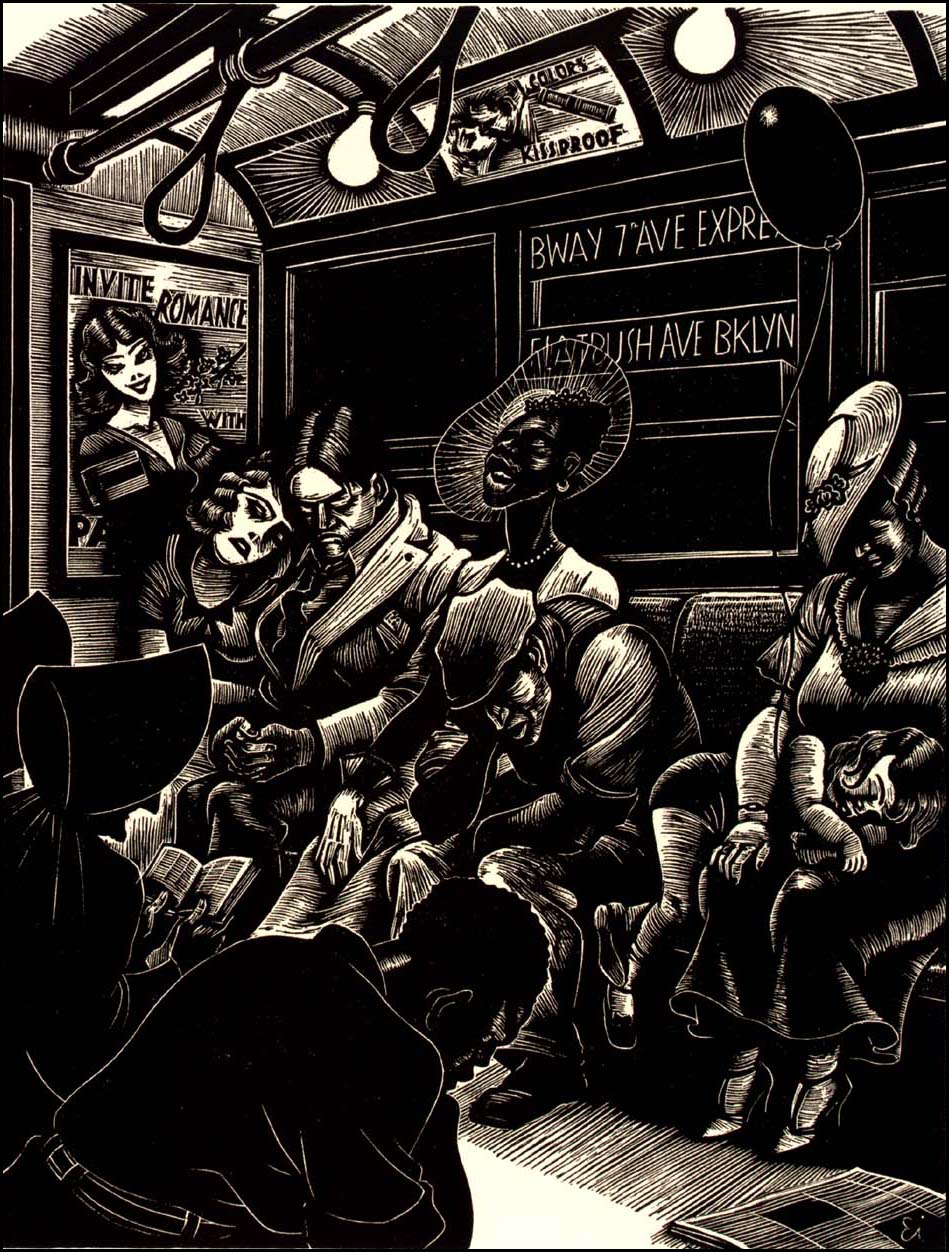
The Subway, 1934, Fritz Eichenberg, Smithsonian American Art Museum
Tired clerks, stake girls, street cleaners, business men,
Boys, priests and harlots, drunkards, students, thieves,
Each one the pleasant outer sunshine leaves;
They mingle in this stifling, loud-wheeled pen.
The gate clangs to- we stir- we sway- and so
We thunder through the dark. The long railroad train weaves
Its gloomy way. At terminal above the eaves
We meet awhile God's day, then night again.Hurled through the dark- 24-hour interval at Manhattan Street,
The rest all night. That is my life, it seems.
Through sunless ways get my reluctant feet.
The sunlight comes in transitory gleams.
And withal the darkness makes the light more sweet,
The perfect lite almost me- in my dreams.
Artwork Connections
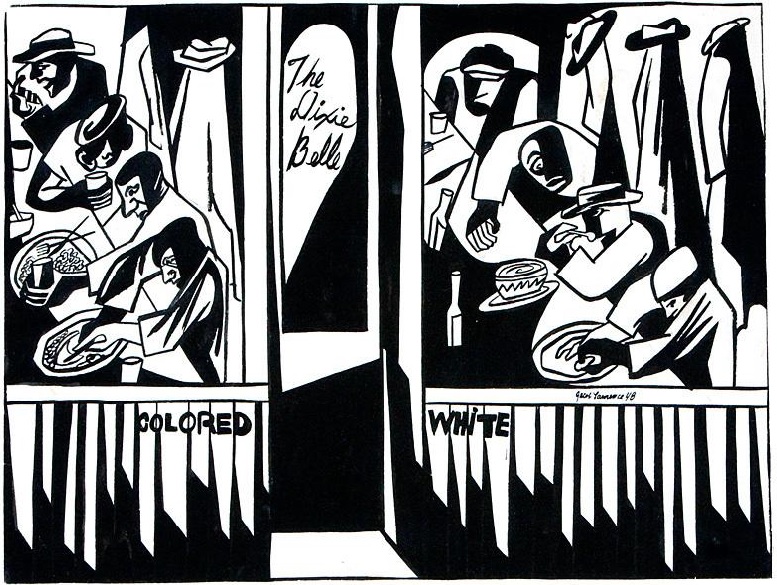 Dixie Cafe , 1948, Jacob Lawrence
Smithsonian National Museum of African American History & Civilisation
Lawrence'southward blackness and white brush and ink drawing utilizes the same side-by-side composition asBar and Grill. Like Bar and Grill, the space reserved for African Americans inDixie Buffet seems constricted and cramped, while the space reserved for whites appears much more than spacious and open. The distinctions between the "colored" and "white" sides of the cafe are put into even starker contrast with the lack of pigment.
 Early Morning time Work, ca. 1940, William H. Johnson
Early Morning Piece of work presents a articulate narrative: the day's chores must be done. Merely the scene is more than than a reminiscence of rural life for many African Americans before the Not bad Migration. Though seemingly archaic, the flattened forms and deliberately naïve perspective Johnson used were informed past years of creative discipline. The man'due south profile is a beautifully rendered drawing of an African mask. Hands and mule hoofs are disproportionately large, while the horizontal stripes offer a visual cadence punctuated by the circular forms of a wheel and chickens pecking at the basis.
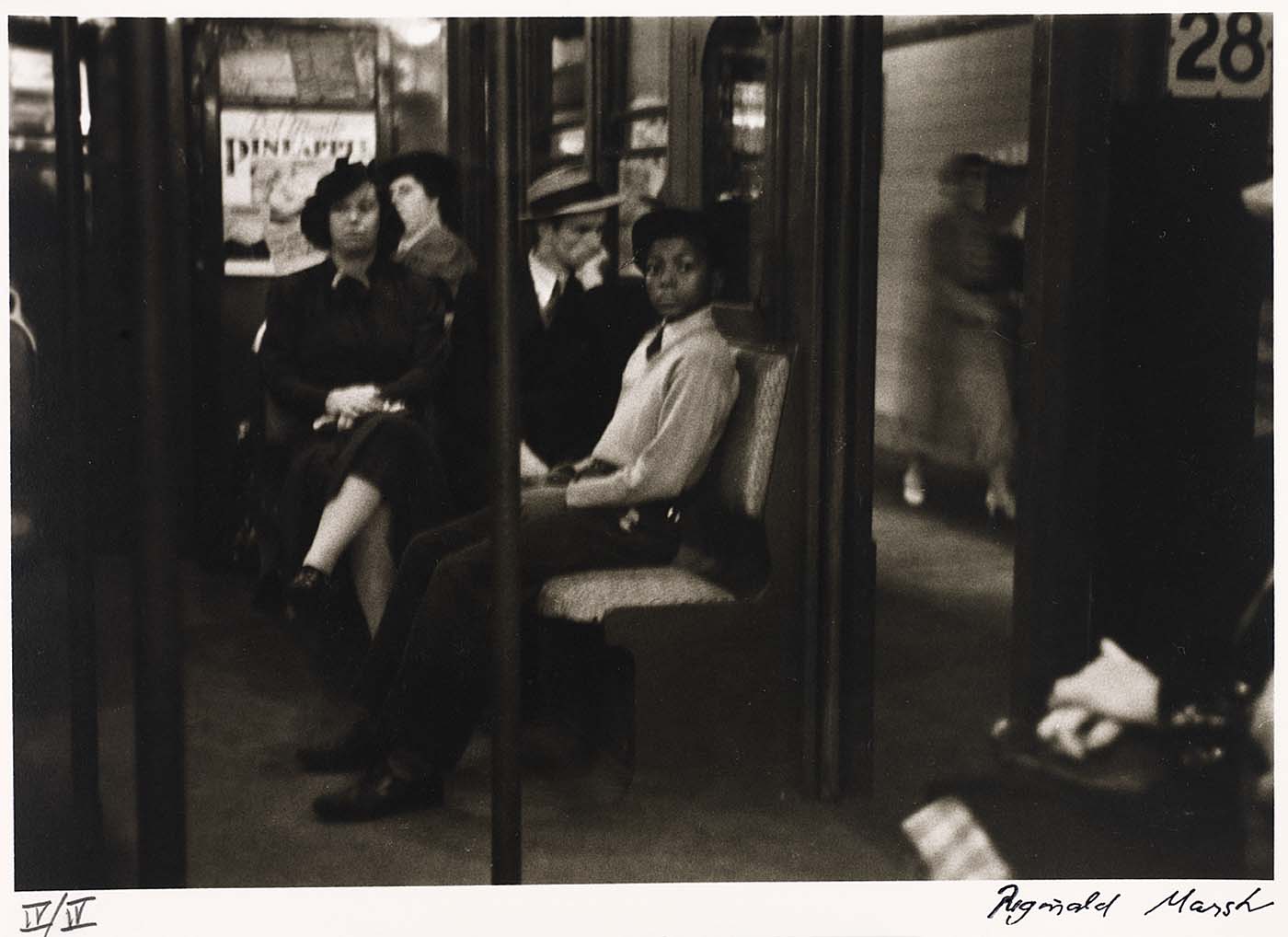
Untitled–Boy on Subway Seat, from the portfolio Photographs of New York , ca. 1938-1945, printed 1976, Reginald Marsh
This photograph was taken sometime between 1938 and 1945 past Reginald Marsh. In paintings, prints, watercolors and photographs, he captured the animation and visual turbulence that fabricated urban New York life an exhilarating spectacle. Marsh'southward subjects were not glamorous or flush New Yorkers, only those in the middle and lower class—Bowery bums, park denizens, and subway riders. Marsh was fascinated past the humanity expressed by those living under astringent economic and social duress.

Street Life, Harlem , ca. 1939-1940, William H. Johnson
In Street Life, Harlem, William H. Johnson portrayed an elegant couple dressed "to the nines" for an evening on the town. Style, equally much equally skin color, was a mark of pride among many African Americans who had come of historic period during the Harlem Renaissance, but the flamboyant appearance of zoot-suiters inflamed racial tensions long afterwards swing music and the jitterbug had been absorbed into American popular civilisation.
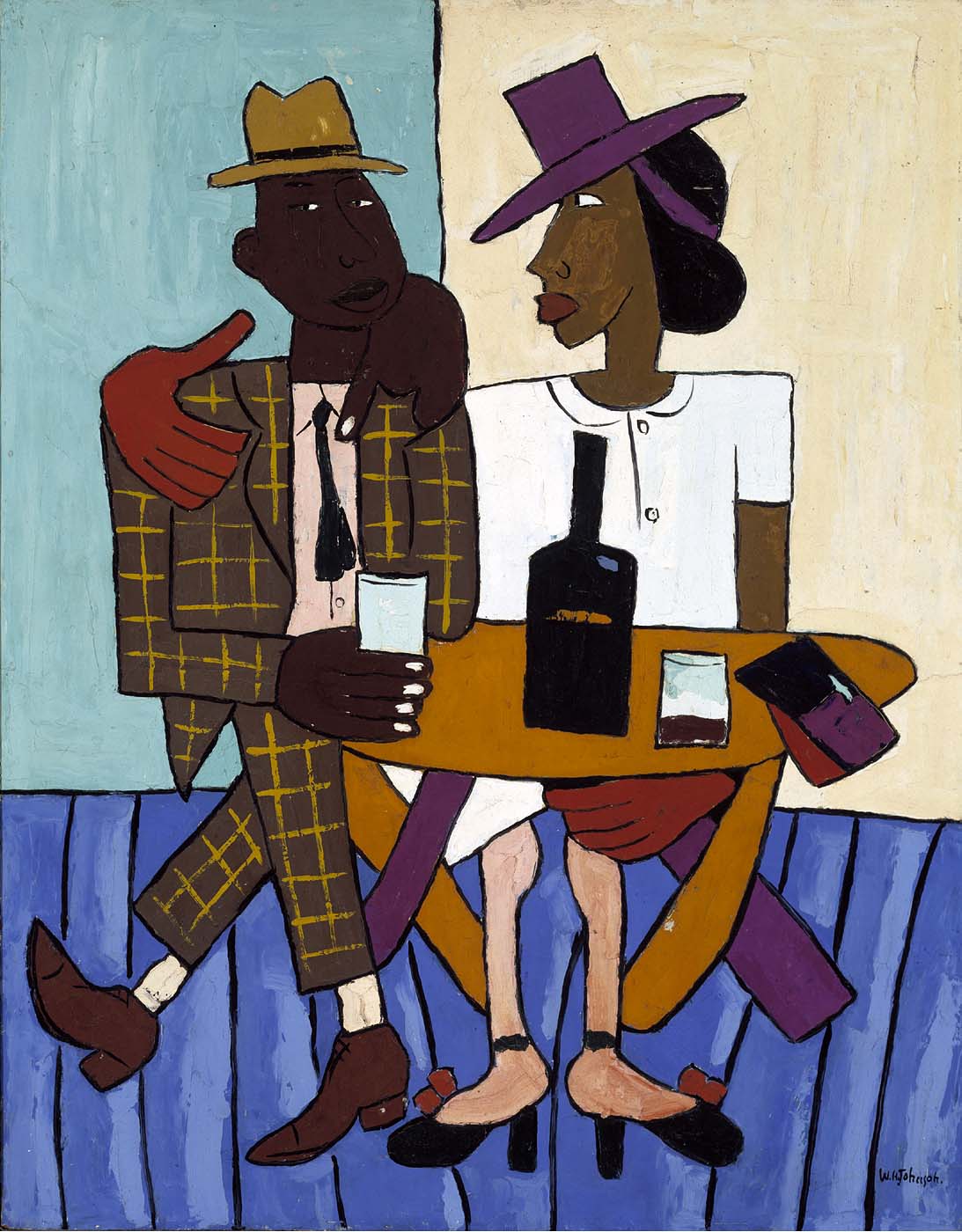
Café, ca. 1939-1940, William H. Johnson
Johnson spent decades traveling the world, searching for the authentic spirit of ordinary people from different cultures. In the late 1930s, he constitute what he was looking for in his ain African American customs. The strong colors and silhouettes in this painting evoke the African fine art that blackness artists and writers had embraced during the Harlem Renaissance. Just this affectionate couple also has the fashionable flash of zoot-suiters in the big band era. Above the tabular array, the two figures coolly take in the café scene; below, a tangle of legs and limbs hints at the erotic energy of a night on the boondocks.
Evening Attire , 1922, James VanDerZee
James VanDerZee'south photo of a Harlem resident is one of thousands of his meticulously composed and polished studio photographs that capture the image and spirit of the New Negro motility—the efforts of black artists, academics, critics, and consumers that promoted African American social issues in the mid-1920s and 1930s. This stylish young woman, perched casually on a table, gazes confidently into the camera while decked out in her evening attire, a fur gracing the shoulders of her fancy beaded dress and flowers filling her arms. The woman's identity is unknown, just her confident begetting, sophisticated attire, and carefully curated surround signify the economic and social aspirations of many African Americans in the 1920s. Proponents of the New Negro movement believed that establishing a thriving center class was necessary before significant civil rights progress could be made. To help foster an ideal of success, many African Americans created stylized images of themselves, a ritual with history in American and European portraiture.
Media
Jacob Lawrence on the Groovy Migration – The Philips Collection (2 mins)
Jacob Lawrence shares his personal and familial ties to the Cracking Migration. Visit Jacob Lawrence: The Great Migration Serial
Langston Hughes & the Harlem Renaissance: Crash Form Literature – PBS (11 min) Tv set-G
Langston Hughes was a poet and playwright in the first one-half of the 20th century, and he was involved in the Harlem Renaissance, which was a cultural move among African Americans of the fourth dimension that produced all kinds of slap-up works in literature, poetry, painting, sculpture, music, and other areas.
How did the Great Migration change America? (1 min) From The Gilder Lehrman Institute on Vimeo.
Boosted Smithsonian Resources
Exploring all xix Smithsonian museums is a keen fashion to enhance your curriculum, no matter what your bailiwick may be. In this section, you'll find resources that we take put together from a diverseness of Smithsonian museums to raise your students' learning experience, broaden their skill set, and not but meet education standards, but exceed them.
Subject: Art
African American Art: Harlem Renaissance, Civil Rights Era, and Beyond – Smithsonian American Fine art Museum
A selection of paintings, sculpture, prints, and photographs by 40-three black artists who explored the African American feel from the Harlem Renaissance through the Ceremonious Rights era and the decades beyond, which saw tremendous social and political changes.
Subject: History
America on the Motion – Smithsonian National Museum of American History
Travel across America to communities inverse by transportation, investigate artifacts and images in the Smithsonian, and explore transportation in American history with historians and curators.
Subject: Language Arts
The Blues and Langston Hughes – Smithsonian Education
Students larn the structure of the blues stanza, both in music and in the blues-based poems of Langston Hughes. This set of lessons is divided into grades Chiliad–2, iii–five, half-dozen–viii, and ix–12. Younger students compose their own three-line dejection poems. Older students mind for details of the Groovy Migration in recordings of rural and urban blues from Smithsonian Folkways.
The Music in Poetry – Smithsonian Teaching
The lessons in this issue introduce students to the rhythms of poetry. The focus in on two poetic forms that originated as forms of song: the Carol stanza, found throughout British and American literature, and the Dejection stanzas of Harlem Renaissance poet Langston Hughes. The exercises take poetry off the page and put it into terms of motility, concrete space, and, finally, music.
Lesson Plans
Life in the Promised Country: African-American Migrants in Northern Cities, 1916-1940 (PDF) – Smithsonian Education
The issue includes a story of two African Americans and their unique journeys to the North. Students analyze the story and put it in context using the groundwork information provided. They are then asked to write a "mag commodity" or an essay based on interviews with a family member or friend who migrated to their customs equally an adult.
Glossary
135thursday Street Library: a branch of the New York Public Library, information technology opened in 1905 and became a cultural epi-centre of the Harlem Renaissance. It hosted the start exhibition of African American fine art in Harlem, and was the merely branch to employ blacks in the 1920s.
A. Philip Randolph: (1889-1979) leader of the African American Civil Rights Movement, Randolph organized the first African American labor wedlock, the Alliance of Sleeping Car Porters.
Alain Locke: (1885-1954) African American author, philosopher, and educator. He has the distinction of being the kickoff African American awarded the Rhodes Scholarship.
Andrew Johnson: (1808-1875) 17th President of the United States. He became president on the death of Abraham Lincoln, having served as Lincoln's vice president. His plans to restore the seceded states to the Union without protection to erstwhile slaves led to his impeachment by the House of Representatives.
Augusta Savage: (1892-1962) African American sculptor and educator active during the Harlem Renaissance. Her studio became the place where the careers of many hereafter generations of African Americans artists started.
Bessie Smith: (1894-1937) American Blues vocalizer. Nicknamed "Empress of the Dejection," Smith was the most popular and successful female Blues singer of the 1920s and 1930s, influencing many musicians of the Harlem Renaissance era.
Civil Rights Act of 1875: a federal law enacted during Reconstruction which intended to guarantee freed blacks equal handling in public accommodations, such as hotels, public transportation, and theaters. The bulk of the constabulary'due south provisions were ruled unconstitutional in 1883 by the Supreme Court.
Countee Cullen: (1903-1946) African American poet and leading effigy of the Harlem Renaissance. He is best known for his poem "Heritage," which reflects an urge to reclaim African arts.
The Crisis : the official mag of the NAACP, founded in 1910.
Duke Ellington: (1899-1974) American composer, pianist, and Jazz band leader. He was the originator of big ring Jazz music. A pioneer of the Harlem Renaissance, Ellington came to national prominence with performances at the Cotton wool Club in Harlem, a famous "whites only" New York City nightclub which featured the nearly pop African American entertainers of the mean solar day.
forty acres and a mule: a concept of state redistribution for freed slaves, whereby Congress authorized the Freedman'due south Agency to oversee the rental of 40 acre parcels of abandoned or confiscated farmland (formerly owned past Southern plantation owners) with the eventual pick to purchase.
Fourteenth Subpoena: (1868) granted citizenship to "all persons born or naturalized in the U.s.a.," which included sometime slaves recently freed. In addition, information technology forbids states from denying any person "life, liberty or holding, without due process of constabulary" or to "deny to any person within its jurisdiction the equal protection of the laws."
Franklin D. Roosevelt: (1882-1945) 32nd President of the United States, commonly known by his initials, FDR. He is best known for his serial of social programs, called the New Deal, which focused on relief, recovery, and reform to combat the effects of the Great Low. He won a record 4 presidential elections, which led to the passage of the 22nd Amendment, barring presidents from serving more than two total terms.
Slap-up Migration: (1910-1930) the first moving ridge of African American migration to the North from the South.
Harlem Renaissance: a renewal and flourishing of African American literary, artistic, and musical culture during the years afterwards World State of war I. Though it was concentrated in the Harlem neighborhood of New York City, the motility expanded throughout northern cities with big African American populations.
Jacob Lawrence: (1917-2000) American artist known for his portrayal of African American life, including his epic "Great Migration" series.
James VanDerZee: (1886-1983) African American photographer, best known for his images of African American New Yorkers.
Jazz Age: a menstruum during the 1920s earlier the Swell Depression where Jazz music and associated dance styles became popular in the Us. The Jazz Age, which originated in New Orleans, Louisiana, glorified the new urban life that many Americans were now leading.
Jim Crow: state enforced segregation and disenfranchisement laws against African Americans; enacted after the Reconstruction era. The term 'Jim Crow' originated in vaudeville-type traveling phase plays where Jim Crow was an African American stock character, a stereotypically shiftless buffoon designed to elicit laughs with his dancing ability and avoidance of work.
Ku Klux Klan: founded in 1865, a post-Civil War secret society which advocates white supremacy and terrorizes minority groups, primarily African Americans.
Langston Hughes: (1902-1967) American poet, novelist, and playwright. His themes of African American life made him a leader of the Harlem Renaissance motility.
Marcus Garvey: (1887-1940) Leader of the Black Nationalist and Pan-Africanism movements, he founded the controversial Universal Negro Comeback Association (UNIA), which was dedicated to racial pride and the formation of an contained blackness nation in Africa.
National Association for the Advocacy of Colored People: (NAACP) African-American civil rights organisation, founded in 1909 to "ensure the political, educational, social, and economic equality of rights of all persons and to eliminate racial hatred and racial discrimination."
National Urban League: a civil rights arrangement based in New York City, founded in 1910.
New Deal: (1933-1938) a serial of domestic social programs and projects enacted by President Franklin D. Roosevelt in an effort to gainsay the crippling effects of the Keen Low. These programs included immediate economic relief, also as reforms in industry, agronomics, and labor.
Plessy v. Ferguson : an 1896 Supreme Courtroom example which upheld the constitutionality of the "separate but equal" doctrine. The case stemmed from an 1892 incident in which Homer Plessy refused to sit in a Jim Crow auto of a passenger train, breaking a Louisiana police force. The Court rejected Plessy's argument that his constitutional rights were violated, ruling that the state police force that implies a legal distinction between whites and blacks did non conflict with the Thirteenth and Fourteenth Amendments to the U.S. Constitution. The decision in Plessy v. Ferguson was not overturned until Brown 5. Lath of Teaching in 1954.
Roaring Twenties: a term used to depict Western civilization in the 1920s – a menstruation of great social and political change.
Romare Bearden: (1911-1988) African American creative person best known for his brightly-colored collages and subjects of African American life.
2d Bang-up Migration: (1941-1970) a term for the 2nd wave of African American migration from the Southward to the N in the years during and subsequently World State of war Two.
sharecropping: a system in which freed blacks rented plots of land in return for giving a portion of their ingather yield to the landowner (frequently their erstwhile main.)
subjugated: to accept been made subordinate or inferior; having been subject field to the dominion or ability of someone else.
Triangular Trade: a pattern of commerce in the trans-Atlantic slave trade in which European textiles, rum, and manufactured goods were used to purchase African slaves; African slaves were sent to the W Indies and America to produce colonial exports; these exports (sugar, tobacco, and cotton wool) were shipped back to Europe.
unions: organized associations of workers designed to protect and further their rights and interests.
W.East.B. Du Bois: (1868-1963) African American civil rights activist, sociologist, and historian. He is best known for his role as co-founder of the NAACP and for his work The Souls of Black Folk – a seminal work in the history of sociology and African American literary history.
World State of war I: (1914-1918) a global war originating in Europe. The Usa formally entered the war in 1917, after a German submarine sunk the New York-leap British rider transport the Lusitania, killing 128 Americans. The attack turned American public opinion against immigrants, fueling a wave of xenophobia. As a issue, immigration decreased and war-fourth dimension industries were drastic to fill jobs normally occupied past immigrants. African Americans seized on this opportunity to escape the Southward, and thus began the Swell Migration.
Zora Neale Hurston: (1891-1960) American novelist and short story writer, she was a pioneer of the Harlem Renaissance era, and is best remembered for her work Their Optics Were Watching God.
Standards
U.S. History Content Standards Era 7 – Emergence of Modernistic America (1890-1930)
- Standard 3A – The pupil understands social tensions and their consequences in the postwar era.
- seven-12 – Examine ascent racial tensions, the resurgence of the Ku Klux Klan, and the emergence of Garveyism.
- 9-12 – Clarify how the emergence of the "New Adult female" challenged Victorian values.
- Standard 3B – The student understands how a modern capitalist economy emerged in the 1920s.
- 5-12 – Explain how principles of scientific management and technological innovations, including associates lines, rapid transit, household appliances, and radio, continued to transform production, piece of work, and daily life.
- vii-12 – Examine the changes in the modern corporation, including labor policies and the appearance of mass advertising and sales techniques.
- ix-12 – Analyze the new business organization downtowns, the development of suburbs, and the part of transportation in changing urban life.
- Standard 3C – The student understands how new cultural movements reflected and changed American gild.
- 5-12 – Examine the contributions of artists and writers of the Harlem Renaissance and assess their popularity.
Source: https://americanexperience.si.edu/historical-eras/modern-united-states/pair-subway-bar-and-grill/
0 Response to "what were the last two cities in the south to be captured"
Post a Comment